
2026 HOLIDAY SHOPPING REPORT
The New Holiday Shopper:
Smarter With AI, Stricter With Budgets
What brands and retailers need to know this holiday season. Insights from 1,164 U.S. shoppers who are stretching every dollar and turning to AI as often as social media to decide what to buy.

1,164
U.S. shoppers surveyed
64%
would buy from a brand they’ve never heard of if AI recommended it
74%
of shoppers plan to spend the same or less this year
⭐ KEY FINDINGS
AI is helping shoppers find the gift, and tighter budgets are deciding when they buy it.
Trusted over search
AI ranks second only to social media as Gen Z and Millennials' most trusted source for gift research, ahead of search engines.
Budgets hold the line
26% of shoppers will spend less this season, the highest share in five years.
Gifts get practical
69% will give everyday essentials this year, and only 12% will prioritize what's trendy.
A generational shift
More than half (51%) of Gen Z plan to use AI for holiday research, up from 44%, while social media fell from 79% to 67%.
The sale sign still works
Nearly half (49%) of shoppers say a big sale banner draws them into a store.
Shoppers wait for the deal
Black Friday/Cyber Monday is now the #1 time to start holiday shopping (28%).
⭐ 01 · BUDGETS, DISCOUNTS & TIMING
Shoppers are holding the line on budgets, and holding out for the deal.
Holiday shoppers aren’t skipping the season. They’re shrinking it. Fewer plan to spend more than at any point since 2022, the discount it takes to win a sale keeps creeping up, and more shoppers are holding their budgets until the biggest promotions arrive.
For retailers, that means a shorter, sharper season where value has to be visible and the timing has to be right.
26% of shoppers will spend less this holiday season, the highest share in five years
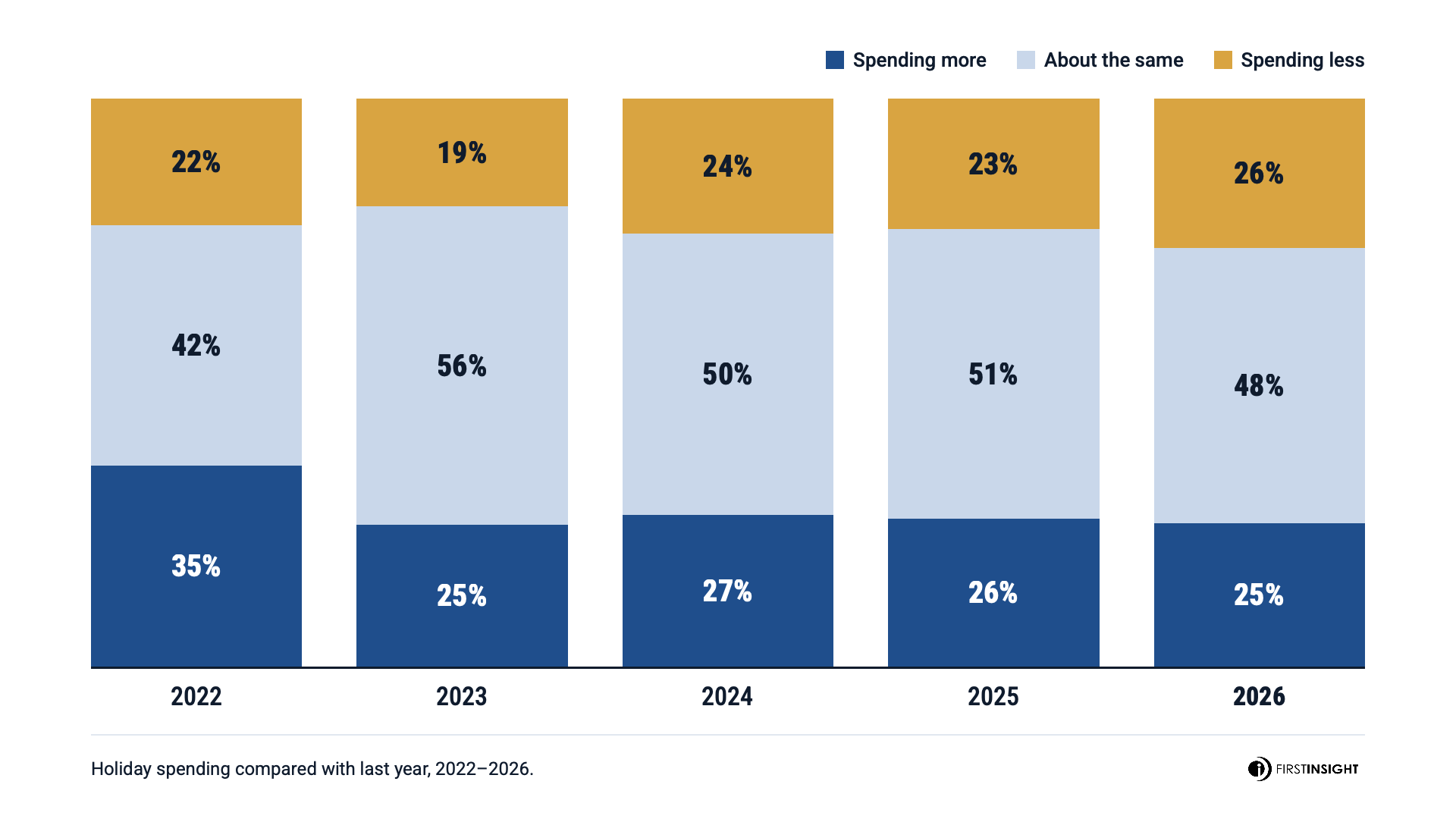
Shoppers are trimming gift lists, not just prices.
The share planning to spend more has slid from 35% in 2022 to 25%. Of those cutting back, 41% will simply buy less overall, far ahead of hunting deals (16%, down from 23% in 2025) or using more coupons (9%, up from 6%).
The split runs by generation: 35% of Boomers will spend less, while 34% of Gen Z plan to spend more. Gen X is the most likely to buy less (52%), and Gen Z leans on secondhand (13%).
35% of shoppers now need 35% off or more to buy, up from 31% in 2025
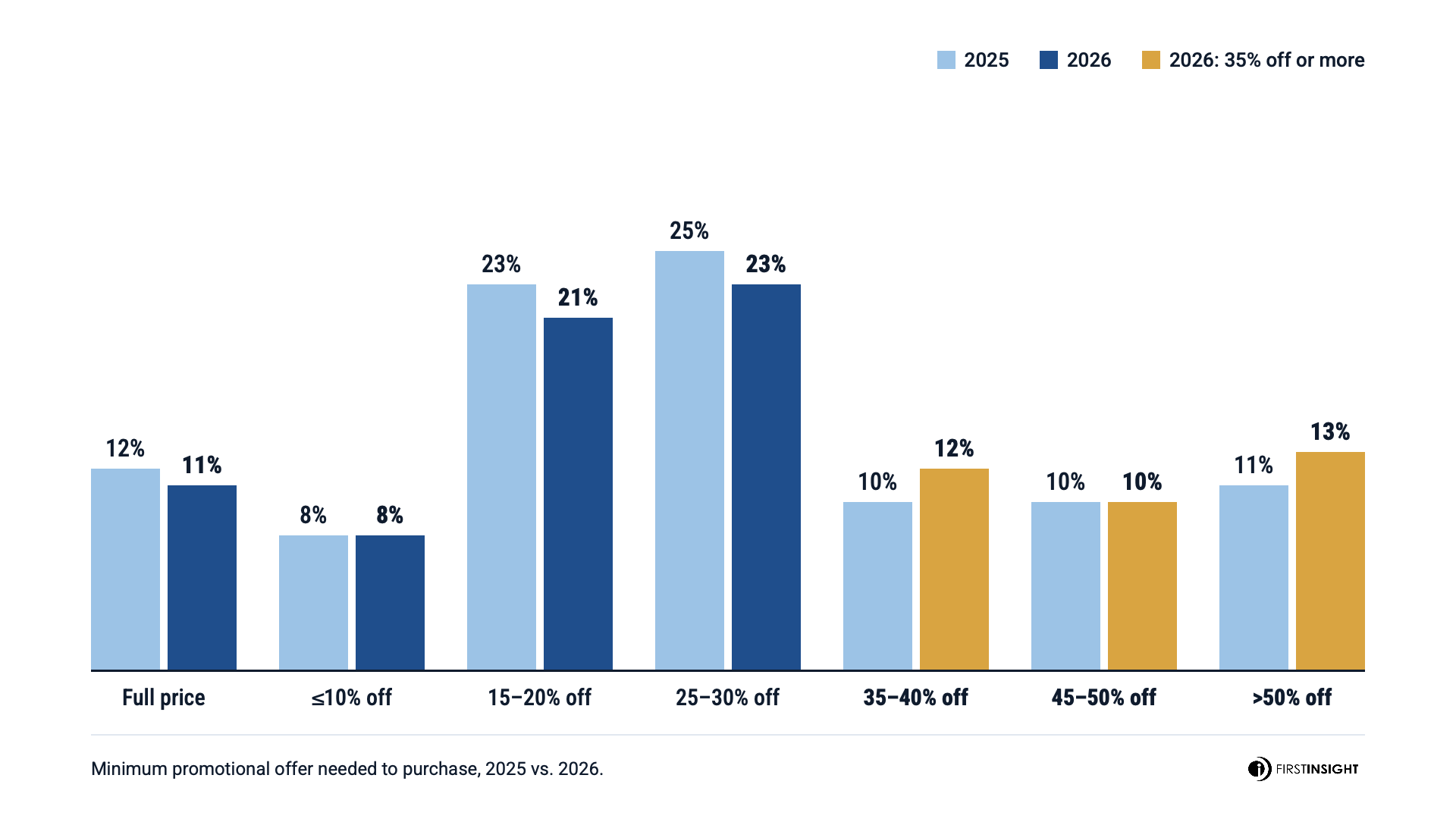
of shoppers won’t buy for less than half off. Only 11% will pay full price.
The deal has to be deeper, and it has to be obvious.
79% of shoppers need at least 15% off before they’ll buy. The movement is at the top end: the share that needs 35% off or more rose four points in a year, while the middle tiers (15% to 30% off) shrank.
28% of shoppers will start at Black Friday/Cyber Monday, the highest share in five years
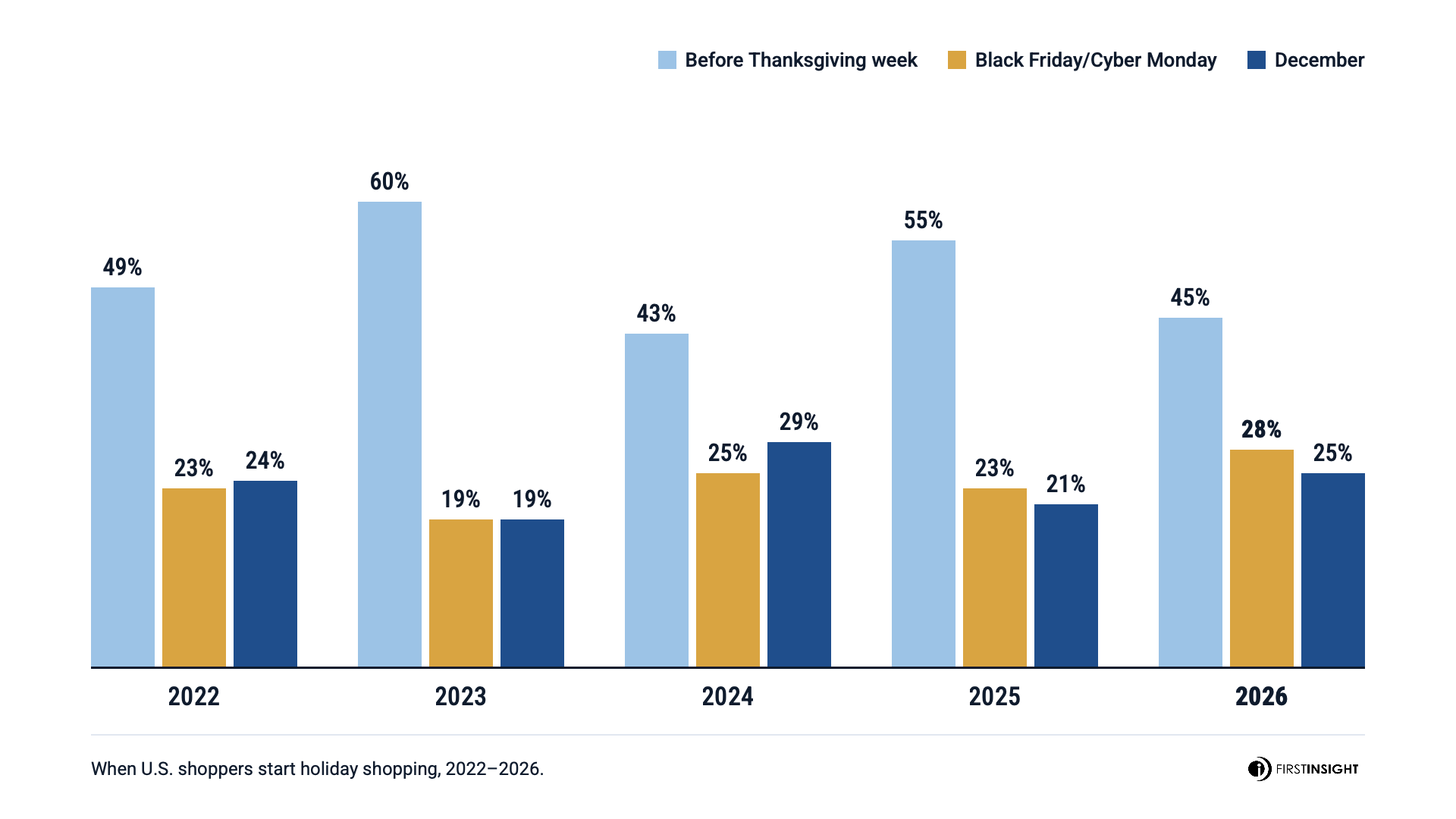
The season is compressing around the big promotions.
45% of shoppers start before Thanksgiving week, down from 55% in 2025 and 60% in 2023. About a quarter (25%) wait until December. Retailers that spend their best offers early risk spending them before most shoppers are ready to buy.
⭐ 02 · PRACTICAL GIFTING
Budget fit beats trendiness, and the socks are going under the tree.
This year’s gift is more likely to be something the recipient needs than something everyone’s talking about. Shoppers are choosing gifts that fit the budget, giving everyday essentials and, for younger shoppers, regifting without apology.
What still unlocks a bigger budget is certainty: knowing the gift is for someone close, or exactly what they asked for.
42% of shoppers say fitting their budget is a top gift priority; only 12% prioritize what’s trendy
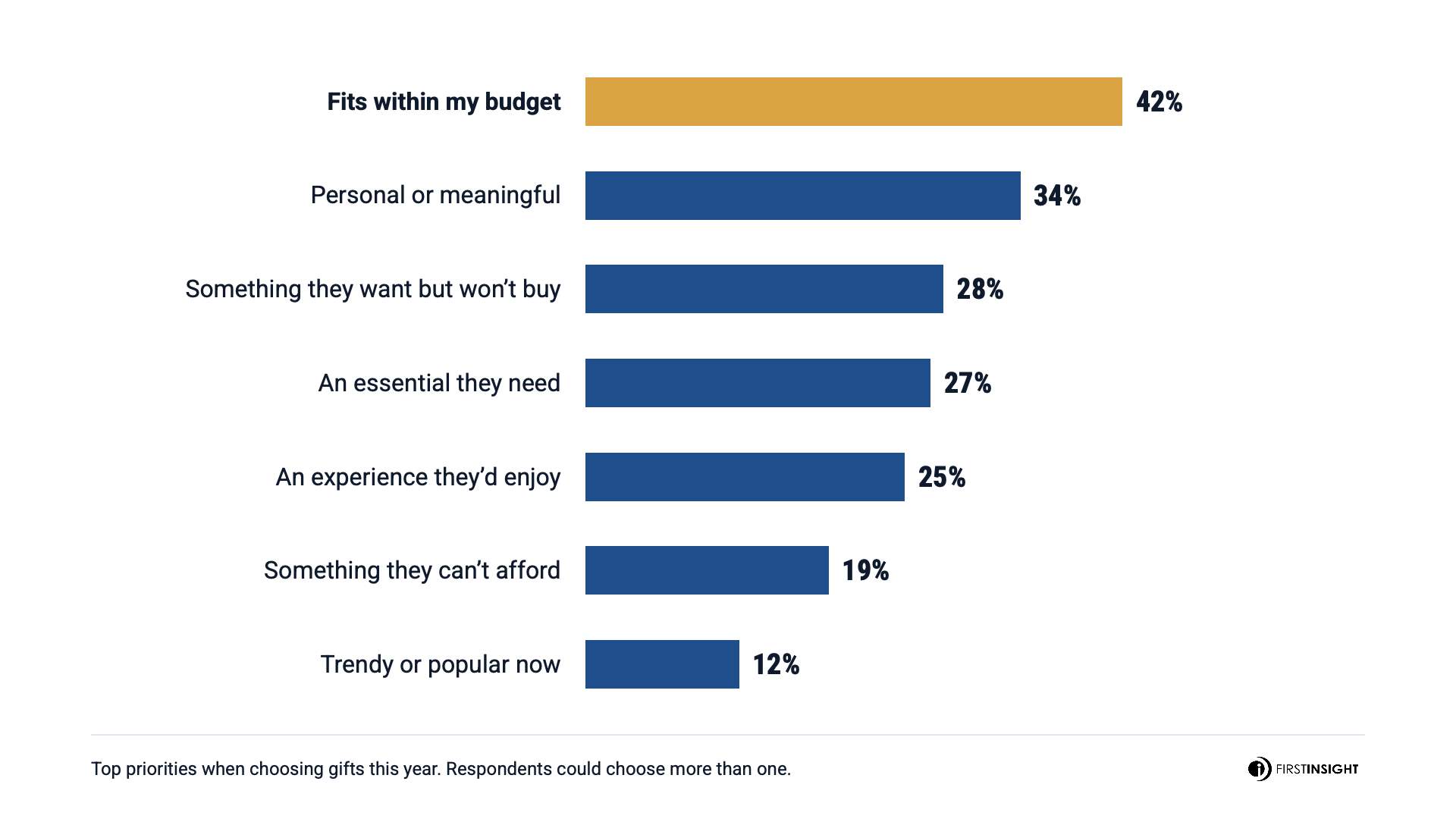
Price and quality are the gift, not the trend.
Price (57%) and quality (50%) are the qualities shoppers look for most in a gift. Fitting the budget now outranks personal meaning (34%). Sustainability matters most to Gen Z: 31%, compared with 21% of shoppers overall.
69%
of shoppers will give everyday essentials as gifts this year, like toiletries, socks and kitchen staples.
Socks, soap and pantry staples are on this year’s gift list
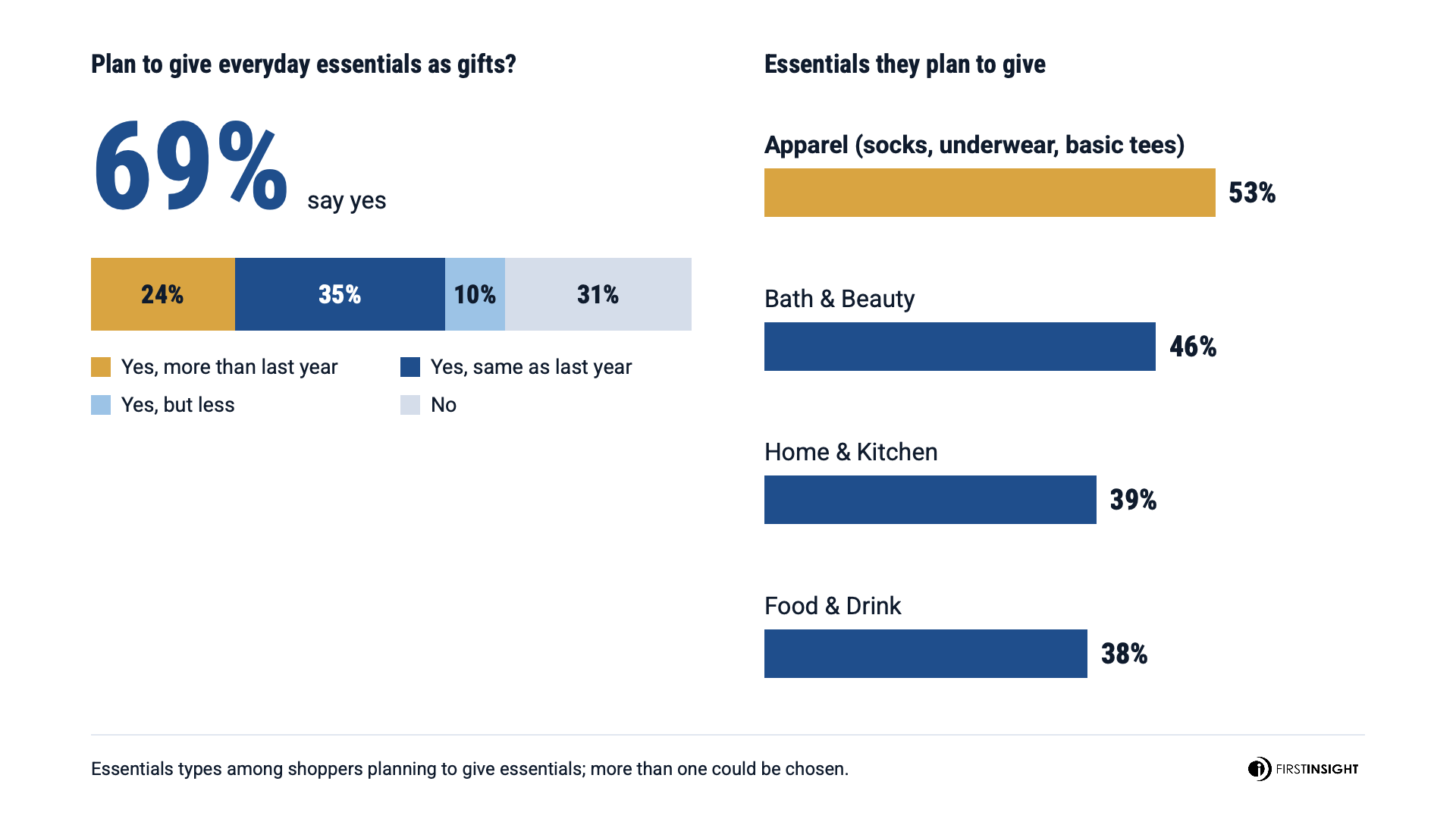
24% will give more essentials than last year, rising to 35% of Gen Z.
Among shoppers giving essentials, apparel like socks, underwear and basic tees leads (53%), followed by bath and beauty (46%), home and kitchen (39%) and food and drink (38%). For retailers, the everyday aisle is part of the gift assortment this year.
42% of Gen Z will regift this year, three times the share of Baby Boomers
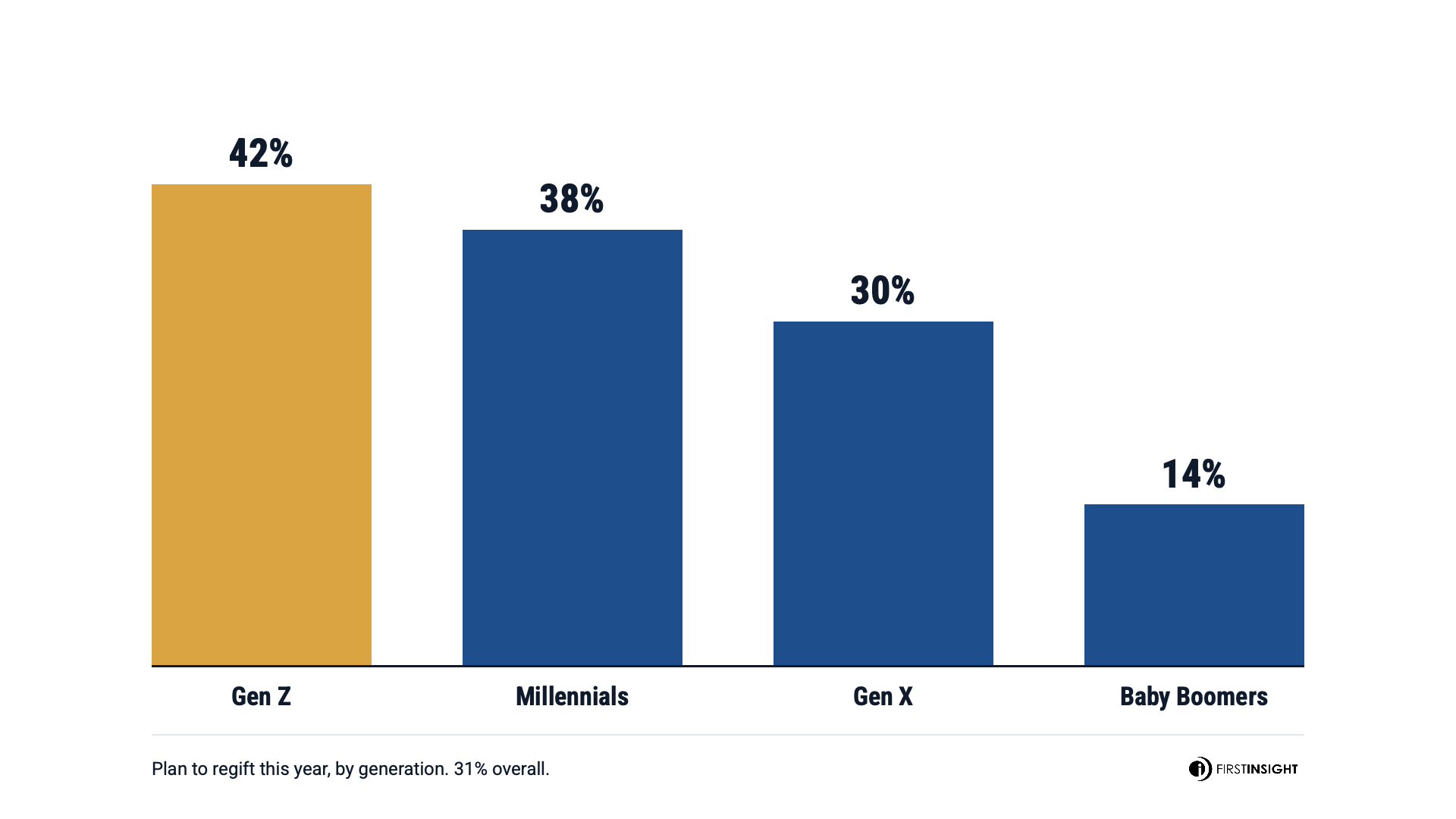
Bath, beauty and candle sets are the season’s most recycled gifts.
31% of shoppers plan to regift this year. The most-regifted items are scented candles (28%), lotion and body wash sets (27%) and makeup palettes or travel-size sets (26%).
What unlocks a bigger gift budget? People and certainty.
27%
will pay more than planned for someone very close, and 26% if it’s exactly what they asked for.
22%
will stretch for a gift that will last longer, and 21% for one that’s made in the USA.
20%
won’t pay more than planned for any reason, rising to 30% of Boomers.
Wish lists take out the guesswork, and that’s when shoppers are most willing to spend more
⭐ 03 · WHERE & WHY THEY SHOP
Price still pulls shoppers in, but it no longer does all the work.
Price and deals have been the #1 reason to choose a store or a site every year since 2022. But the gap is closing: convenience and selection now share the spotlight, and nearly half of shoppers will move between stores and screens.
Price is still the top reason to shop, but in-store it has fallen from 70% in 2022 to 53%
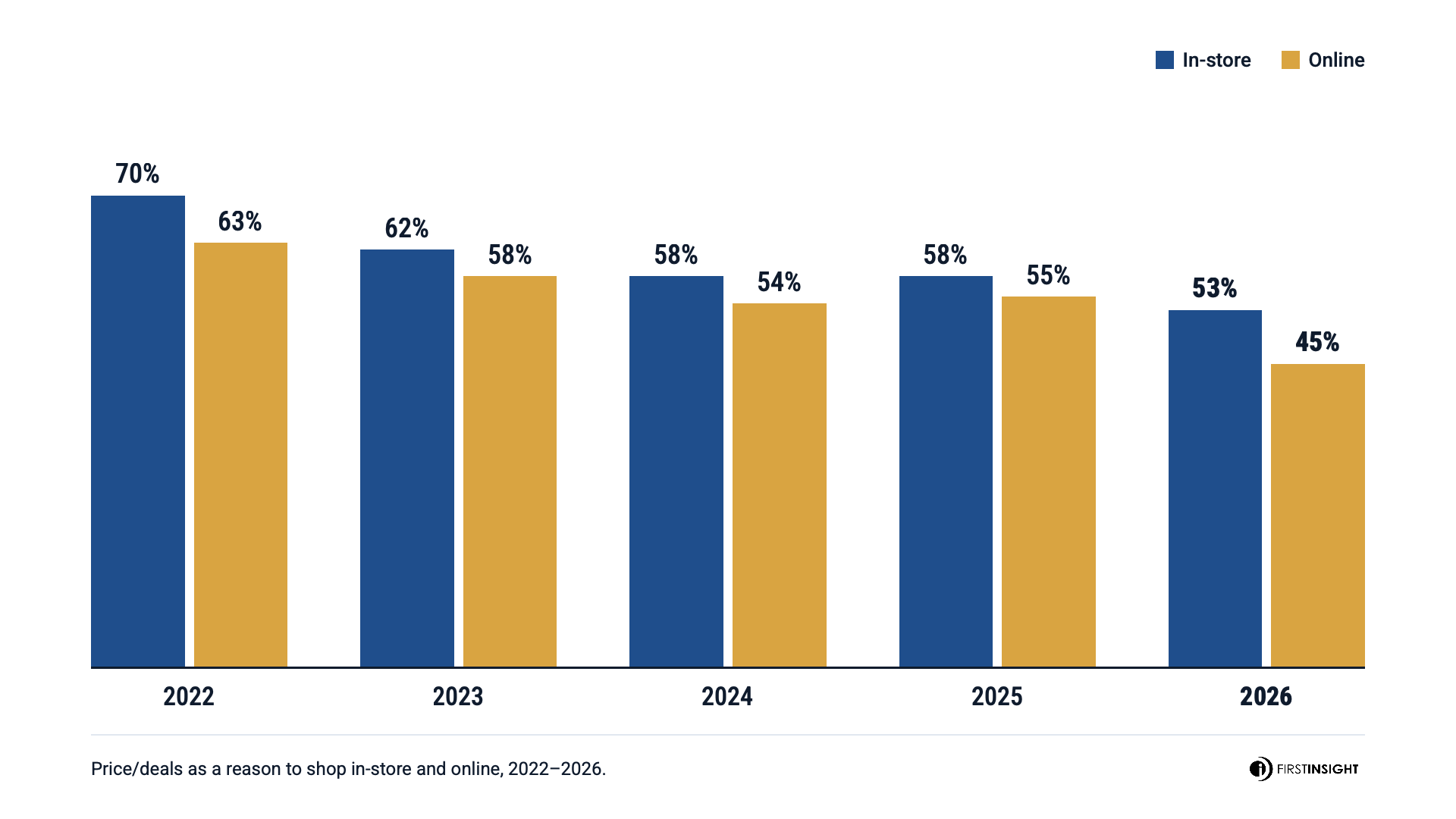
Online, price had its sharpest drop this year.
Price and deals fell from 63% to 45% as a reason to shop online, including a 10-point drop since 2025. Online-only shoppers have dropped from 33% in 2022 to 26%, and 47% will shop both channels.
49%
of shoppers say a big sale banner draws them into a store. Make the deal visible from the sidewalk.
Apparel and footwear lead holiday lists
Online, the top categories are athletic footwear (21%), casual wear (20%) and casual footwear (19%). In-store, casual wear leads (22%), followed by athletic footwear (19%) and loungewear (18%).
Big-box stays the favorite, but it’s slipping
24% prefer big-box retailers like Target and Walmart, down from 28% in 2024. eCommerce marketplaces hold steady at 15%. Boomers lean hardest on big-box (30%).
Shipping worries ease to 51%
Concern about delays is down from 57% last year. 84% will still pay for shipping, but 34% of Boomers won’t pay anything for it. Free shipping is the lever for older shoppers.
⭐ 04 · SOCIAL, AI & THE TRUST GAP
AI is where social commerce was not long ago, and shoppers are ready to buy what it recommends.
For years, social media was the place new brands got discovered. This season, 41% of shoppers will use AI for holiday shopping, the same share that will buy on social platforms. Social research has slipped from 64% in 2022 to 53%, and Facebook, YouTube, Instagram and Pinterest all hit five-year lows for holiday research.
Gen Z is leading the shift: their AI use rose from 44% to 51%, while their social media use fell from 79% to 67%. Still, there’s an AI trust gap. Shoppers lean on AI to find the deal, but proof, like reviews and an exact match, is what turns its pick into a purchase.
49% of AI shoppers use it to compare prices; only 9% plan to buy through it
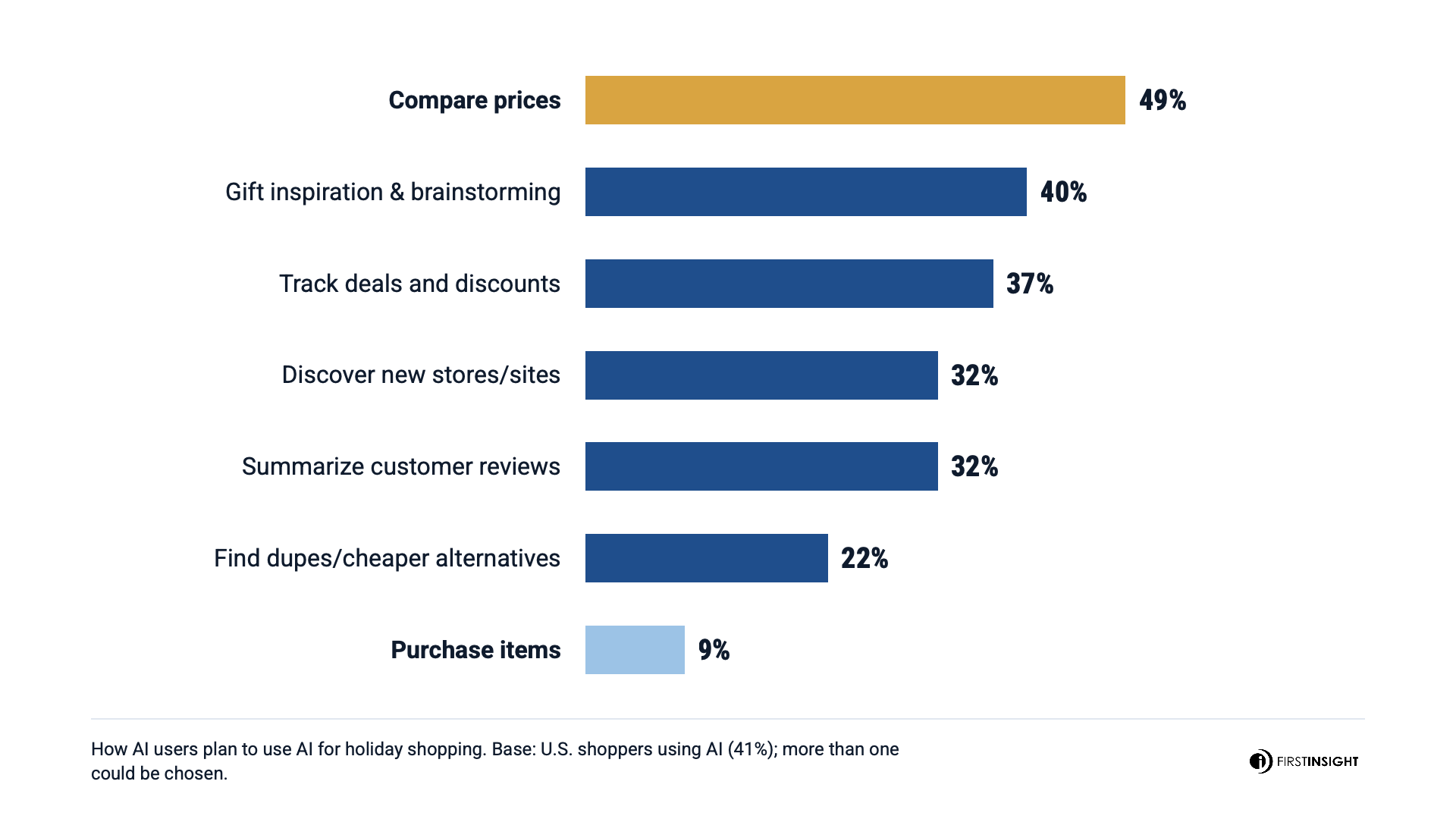
68%
of AI users are willing to buy inside an AI app. Only 9% plan to.
The door to AI checkout is open, but not everyone is walking through it yet.
Willingness to buy directly in AI held at 68% of AI users, flat with 2025. The biggest shift came from Boomers, who jumped to 64% from 57%, closing most of the gap with Gen Z (71%) and Millennials (70%). Willingness is running ahead of behavior.
The AI trust gap: Gen Z and Millennials rank AI as the second-most trusted channel for gift research
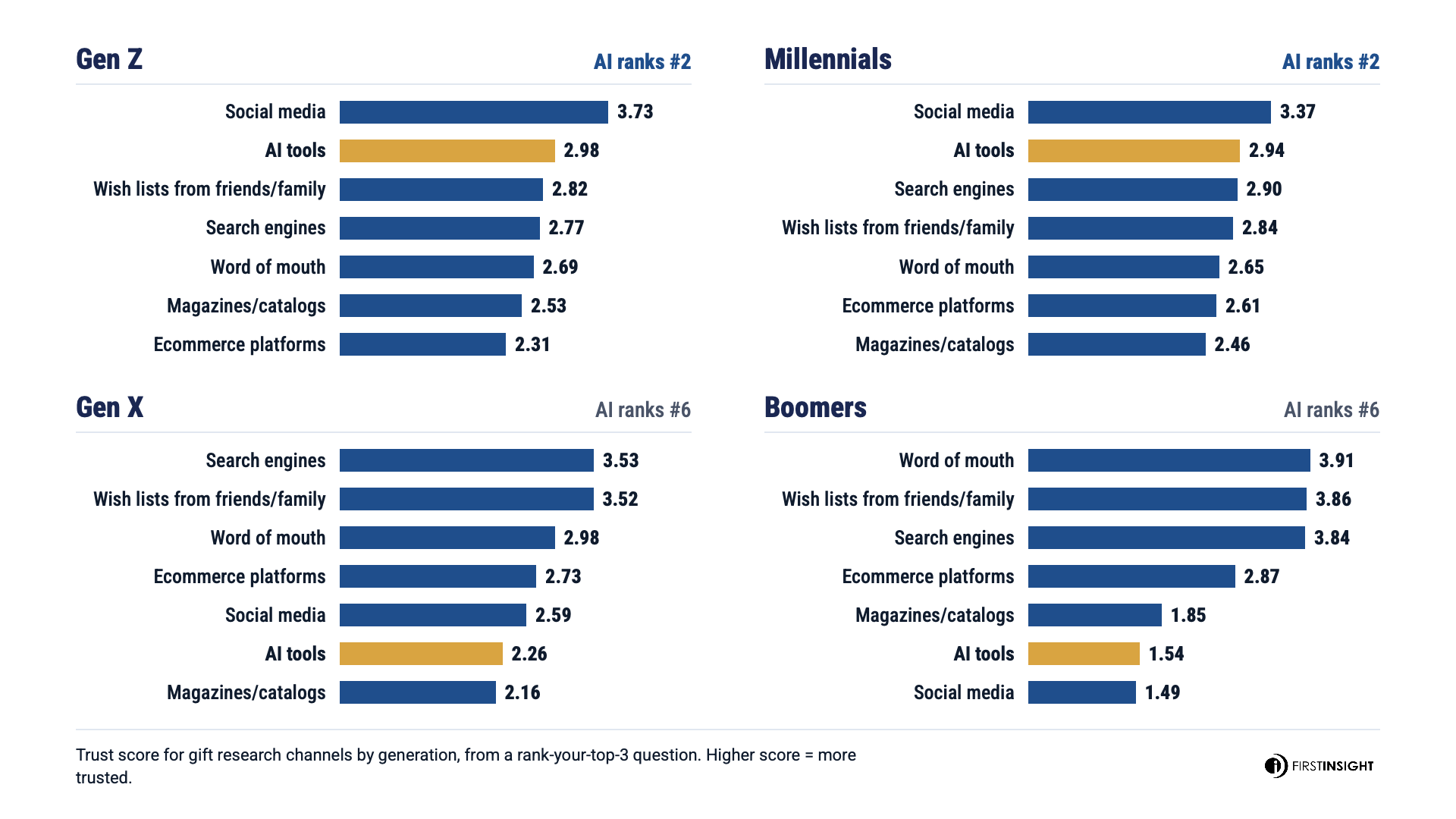
AI is second only to social media for younger shoppers researching gifts.
Gen Z and Millennials trust AI tools more than almost any other source when they're researching gifts. They rank second, behind only social media and ahead of search engines, wish lists and word of mouth. Older shoppers aren't there yet, with 61% of Boomers saying AI hasn't made shopping any easier, compared with 43% of shoppers overall.
AI users are most likely to trust a pick that matches exactly what they described (42%) or has strong customer reviews, ahead of best price (37%) or a brand they already know (34%).
64%
of shoppers would buy from a brand they’ve never heard of if AI recommended it: 20% outright and 45% if reviews or their own research back it up.
⭐ WHAT IT MEANS FOR RETAILERS
Winning the 2026 holidays comes down to value, timing and trust.
WHAT COMES NEXT
AI is following the path social commerce took, from a place to research to a place to buy. The brands AI recommends will be the ones whose product data is precise and whose reviews back it up.
Prove the value before you discount
Show shoppers why a gift is worth it, whether that’s quality, how long it lasts or how personal it feels, so price isn’t the only reason to buy.
Save your best offers for the peak
More shoppers are waiting for Black Friday and Cyber Monday to start, so plan the strongest promotions around those days and early December.
Plan for practical and special
Build assortments with useful everyday gifts alongside a few standout pieces, since many shoppers, especially Gen Z, are buying both.
Make product data AI-ready
Precise descriptions and strong reviews earn the click from an AI recommendation. Data is the 10% of AI investment that decides whether the other 90% works (BCG).
Meet each generation where it shops
Reach Gen Z through AI and social, and give older shoppers clear pricing and free shipping.
Make the store worth the trip
Use seasonal displays and an inviting look to pull shoppers in, with deals that are easy to see from the sidewalk.
Get the full 2026 Holiday Shopping Report
Methodology
1,164
U.S. shoppers, fielded online
Nov. 2026
when the survey was fielded
5 years
of trend data, from First Insight’s 2022–2025 consumer holiday studies
This study was conducted online among 1,164 U.S. consumers in November 2026. Trend comparisons use First Insight’s consumer holiday studies from 2022 to 2025. Some questions were shown only to relevant shoppers (for example, AI users); bases are noted on each chart in the full report.
Respondents: Gen Z 22%, Millennials 26%, Gen X 28%, Baby Boomers 24%. 52% women, 46% men, 1% non-binary. South 40%, Midwest 23%, Northeast 20%, West 18%.
Published November, 2026 · Cite as: First Insight, 2026 Holiday Shopping Report
⭐ FAQ - HOLIDAY SHOPPING TRENDS
Holiday shopping trends: frequently asked questions
Who is the new holiday shopper?
The new holiday shopper is smarter with AI and stricter with budgets, according to First Insight's 2026 Holiday Shopping Report. Seventy-four percent (74%) of U.S. shoppers plan to spend the same or less than last year and 35% need at least 35% off to buy. At the same time, 41% will use AI to shop compared with 53% who'll turn to social media.
Would shoppers buy from a brand they've never heard of if AI recommended it?
Most would. 64% of U.S. holiday shoppers are open to buying from a brand they've never heard of if AI recommended it, according to First Insight's 2026 Holiday Shopping Report. That includes 20% would buy outright and 45% who would buy if reviews or their own research backed it up. Gen Z is the most open at 74% (27% would buy outright), while 52% of Baby Boomers would stick with brands they know.
Is AI replacing social media for holiday shopping?
It's catching up. 41% of U.S. shoppers will use AI for holiday shopping this year, the same share that will buy on social media platforms, according to First Insight. Social media use for holiday research has fallen from 64% in 2022 to 53%. The shift is sharpest among Gen Z, whose AI use rose from 44% to 51% while their social media use fell from 79% to 67%.
What is the AI trust gap in holiday shopping?
The AI trust gap is the divide between younger and older shoppers in how much they trust AI to help them find gifts. In First Insight's 2026 Holiday Shopping Report, Gen Z and Millennials rank AI as their second-most trusted source for gift research, behind only social media and ahead of search engines, wish lists and word of mouth. Older shoppers are more skeptical, and 61% of Boomers say AI hasn’t made shopping any easier. Brands that show up in AI recommendations have a real opening with younger shoppers, since 74% of Gen Z would buy from a brand they’ve never heard of if AI recommended it.
How are consumers using AI for holiday shopping?
Mostly as a value tool. 41% of U.S. shoppers will use AI for holiday shopping this year, up from 39% in 2025, according to First Insight. Among them, 49% will use it to compare prices, 40% for gift inspiration and 37% to track deals. 68% of AI users say they're willing to buy directly inside an AI app, but only 9% plan to.
Are consumers spending more or less on the holidays in 2026?
Most are holding the line. 74% of U.S. shoppers plan to spend the same or less than last year, according to First Insight's 2026 Holiday Shopping Report. More than a quarter (26%) will spend less, the highest share in five years of tracking, while the share spending more has slid from 35% in 2022 to 25%. Of shoppers cutting back, 41% will simply buy less overall.
How big a discount do shoppers need during the 2026 holidays?
35% of shoppers need at least 35% off to make a purchase, up from 31% in 2025, according to First Insight. 79% need at least 15% off, 13% won't buy for less than half off and only 11% will pay full price.
When do most people start holiday shopping in 2026?
Black Friday/Cyber Monday is now the most common starting point. Twenty-eight percent (28%) of shoppers start then, the highest share in five years of First Insight's tracking. More than four in 10 (45%) start before Thanksgiving week, down from 55% in 2025 and 60% in 2023, and 25% wait until December.
What kinds of gifts are shoppers prioritizing for the 2026 holidays?
Practical ones. Fitting the budget is the top gift priority (42%), ahead of personal meaning (34%), and only 12% prioritize what's trendy, according to First Insight. 69% plan to give everyday essentials as gifts, led by apparel (53%) and bath and beauty (46%). Apparel and footwear also lead holiday shopping lists online and in stores.
How was First Insight's 2026 Holiday Shopping Report conducted?
First Insight surveyed 1,164 U.S. consumers online in November 2026. Trend comparisons use First Insight's consumer holiday studies from 2022 to 2025. Some questions were shown only to relevant shoppers, such as AI users, and the base for each chart is noted in the report.
⭐ FAQ - FOR BRANDS AND RETAILERS
For brands and retailers: frequently asked questions
How can retailers predict which products will sell before production?
Ask the consumers who will buy them, before the money is spent. This season the margin for error is thin: 74% of U.S. shoppers plan to spend the same or less than last year, and 41% of those cutting back will simply buy fewer items, according to First Insight's 2026 Holiday Shopping Report. First Insight gathers feedback from real consumers on real products, often before the products exist, and its Value Score™ rating scores each product from 1 to 10 on appeal, purchase intent and price sensitivity. Products scoring 8 or above are strong candidates to move forward; below that, the platform shows which attribute, such as price, design or target persona, is holding the score down.
What is predictive consumer intelligence?
Predictive consumer intelligence combines direct feedback from real consumers with AI and predictive modeling to forecast what customers will buy and what they'll pay before a retailer commits to a product. Unlike traditional consumer research or trend reports, it predicts how specific consumers will respond to specific products rather than describing what already happened. First Insight is a predictive consumer intelligence platform used by more than 600 brands, including Under Armour, Marks & Spencer, Family Dollar and Grupo Coppel.
How do retailers test products and prices with real consumers before launch?
By putting product concepts, designs and prices in front of their target shoppers before production. First Insight tests products with real consumers drawn from a network of more than 360 million people across 180 countries, and can test the same product against multiple consumer profiles, such as different generations, personas or regions, in a single study. Those differences matter: in First Insight's 2026 Holiday Shopping Report, 34% of Gen Z plan to spend more this holiday season, while 35% of Baby Boomers plan to spend less. Teams can then ask Ellis, First Insight's AI copilot, questions about the results in plain language.
How can retailers find out how deep a discount they really need?
By measuring price sensitivity with consumers before setting promotions. Discount expectations are rising: 35% of shoppers need at least 35% off to buy this holiday season, up from 31% in 2025, and only 11% will pay full price, according to First Insight's 2026 Holiday Shopping Report. First Insight's Value Score™ rating measures price sensitivity alongside product appeal and purchase intent, so retailers can see what a product is worth to shoppers before deciding how deep to discount it.
Why isn't historical sales data enough to plan the holiday season?
Because last year's sales only show what shoppers bought under last year's conditions, and holiday behavior is shifting quickly. First Insight's 2026 Holiday Shopping Report found that Black Friday/Cyber Monday is now the most common time to start shopping (28%), 41% of shoppers will use AI to shop, and price as a reason to shop in-store has fallen from 70% in 2022 to 53%. Predictive consumer intelligence asks real consumers about real products before inventory is locked in, instead of relying on what already sold.
What data does retail AI need to make better product decisions?
Forward-looking consumer data, not just historical transactions. Most retail AI investment goes to people and processes (70%) and technology (20%), with only 10% going to data and algorithms, the part that determines whether AI works, according to BCG. First Insight supplies that layer: signals from real consumers on real products, which power Ellis, its AI copilot built on a predictive retail LLM, and connect to the PLM, ERP and planning systems retailers already use.
How can brands get recommended by AI shopping tools?
Give AI accurate, specific product information and strong social proof. According to First Insight's 2026 Holiday Shopping Report, shoppers trust an AI gift pick most when it matches exactly what they described (42%) and has strong customer reviews (40%), ahead of the best price (37%) or a brand they already know (34%). 64% of shoppers would buy from a brand they've never heard of if AI recommended it, which makes precise product data and reviews an opening for newer and smaller brands.
How can retailers win holiday shoppers in 2026?
First Insight's 2026 Holiday Shopping Report points to value, timing and trust. Lead with visible value, since 35% off or more is now the threshold for a third of shoppers. Hold promotional firepower for Black Friday/Cyber Monday and early December. Merchandise practical gifts such as essentials, apparel and budget-friendly bundles. Make product data AI-ready with precise descriptions and strong reviews. And let the storefront sell: a big sale banner draws in 49% of shoppers.
What is First Insight?
First Insight is a predictive consumer intelligence platform that tells retailers what consumers will buy before they do. More than 600 brands, including Under Armour, Marks & Spencer, Family Dollar and Grupo Coppel, use First Insight to decide what to design, what to buy and what to cut before they invest. Its proprietary Value Score™ rating and Ellis, an AI copilot built on a predictive retail LLM, turn feedback from real consumers into decisions. First Insight was founded in 2007 and has tracked U.S. holiday shopping since 2022.
First Insight tells retailers what consumers will buy before they do.
More than 600 brands, including Under Armour, Marks & Spencer, Family Dollar and Grupo Coppel, use First Insight’s Value Score™ and Ellis, its AI copilot, to decide what to design, what to buy and what to cut before they invest. A decision, not a dashboard.
For media
For interviews, charts or additional data from the report, contact our press team.
About First Insight
First Insight is a predictive consumer intelligence platform that brands and retailers rely on from product creation to marketing. First Insight combines direct feedback from real consumers with AI and predictive modeling to help them understand what customers are likely to buy, what they’re willing to pay and where to invest. Its proprietary Value Score™ rating measures product appeal, purchase intent and price sensitivity, drawing on a network of more than 360 million consumers across 180 countries. Companies including Under Armour, Boden and Family Dollar use First Insight to guide product, pricing and assortment decisions before development costs and inventory are locked in. First Insight was founded in 2007.