



According to New Research from First Insight, National CPG Brands “Stand Out” Less to Gen Z Consumers as Private Label, Premium and Direct-to-Consumer Products Become More Considered Alternatives
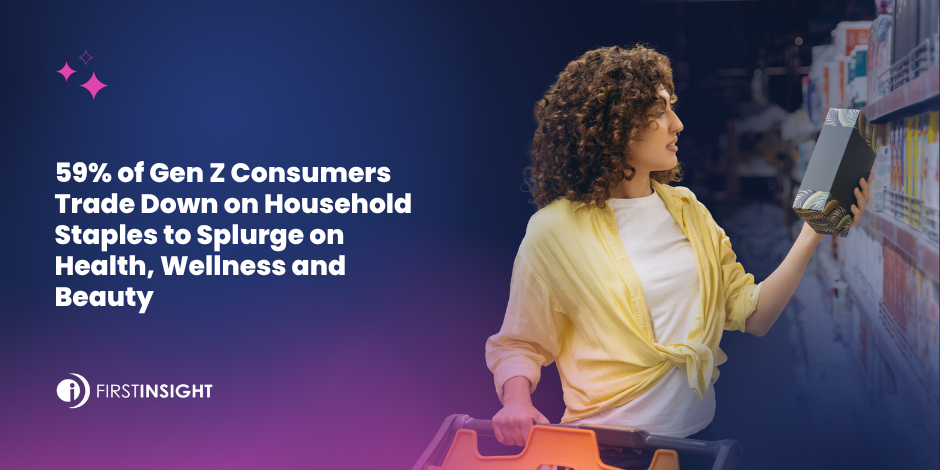
Pittsburgh, PA (March 24, 2026)--First Insight, the company that leverages AI to transform consumer feedback into profitable retail strategies, has released findings from its latest study, Is Gen Z Still Choosing Your Brand? Here’s What’s Quietly Changing Across CPG. The study reveals that Gen Z still ranks national brands #1 in purchase preference across every shelf-test category — beating store brands, premium and direct-to-consumer (DTC) alternatives alike. But 59% of Gen Z consumers actively trade down in one category to fund a premium purchase in another — cutting staples like food and beverages and household goods to splurge in health and wellness (25% willing to pay a premium) and skincare and beauty (22%). Nearly one-third (31%) say they are most likely to purchase private label or store brand food and beverages to save money, and 24% say the same for household goods.
Gen Z consumers are also significantly less driven by the prestige and name recognition of national brands. When asked which brand “stands out first,” Gen Z respondents consistently trailed Boomers in naming established national brands compared to private label, DTC and premium alternatives. For example, when shown photos of multi-purpose cleaners across these brand types, 68% of Boomers said the national brand stood out first versus 44% of Gen Z. Similarly, 79% of Boomers selected the leading national brand of facial cleanser compared to 52% of Gen Z, with similar gaps appearing with dog food and vitamins. Yet when asked to rank brands by purchase preference, Gen Z still chose national brands #1 in every category — ahead of store brand, premium, and DTC challengers alike.
The more telling signal is what happens in between: national brands lose engagement from “standout” to “learn more” interest, while store brand, premium, and DTC challengers gain attention. CeraVe, a national brand, stands out to 52% of Gen Z, but only 33% want to learn more — a 19-point drop. Blueland, a DTC brand of cleaning products, stands out to just 18% of Gen Z, but 30% want to learn more — a 12-point gain. Notably, national brands are not being rejected: Gen Z’s “least likely to choose” scores barely differ from the total population, never more than three points.
The erosion is indifference at the top of the funnel, not hostility. This pattern mirrors findings from First Insight's 2025 private label research, in which 45% of consumers reported permanently switching from a national brand to a store brand when quality met expectations — suggesting the preference gap, once opened, tends to stay open.
First Insight, which works with leading retailers and brands to understand what drives trial, preference and repeat purchase, recommends that companies engage consumers directly to identify where they are most willing to shift to lower-cost options, where they are willing to invest more and how products should be positioned to resonate across channels and categories. Is Gen Z Still Choosing Your Brand? Here’s What’s Quietly Changing Across CPG offers a macro view of how Gen Z’s evolving perceptions of value, identity and brand choice are reshaping purchasing decisions in today’s CPG landscape. First Insight’s report is based on responses from 2,151 respondents ranging from 18 to 80+ years old.
Among the findings:
- Price and quality remain the top purchase drivers, but their importance shifts by category. In the household goods and food and beverage categories, the price of products is the primary motivator for making a purchase (30% and 33%, respectively), followed by quality (29% and 30%, respectively). However, quality is the top factor for skincare and beauty (33%) and health and wellness (35%) products.
- Dollar stores are becoming a go-to spot for grocery shopping. Forty-two percent (42%) of Gen Z and Gen X, and 40% of Millennials, say they have purchased food/beverages from chains like Dollar General and Dollar Tree in the past month. This is significantly more than Boomers, with only 25% saying the same.
- Most Gen Z and Millennials have at least one subscription. Only 25% of Gen Z and 28% of Millennials (ages 29-44) say they are not subscribed to any product-based subscription services, compared to 55% of Gen X (ages 45-60) and 69% of Boomers (ages 61+) who say the same. Food and beverage subscriptions are the most popular for Gen Z (34%) and Millennials (31%).
- Even among generations most open to subscriptions, conversions require a clear value trigger. Forty-four percent (44%) say a product is worth subscribing to instead of buying in-store if there are discounts or cost savings, 34% cite exclusive product offerings not available in-store, and 33% cite convenience.
The research identifies three distinct Gen Z buyer archetypes that operate simultaneously — often within the same shopping trip. The Value Seeker shops for the best deal and dominates food and household categories. The Identity Shopper prefers natural, eco-friendly and premium options and dominates health, skincare and pet categories. The Creature of Habit buys by recognition and is most concentrated in pet food — the last category where brand inertia holds. For CPG brands, the strategic implication is significant: the same Gen Z consumer who chooses store-brand cereal will pay a premium for AG1. Understanding which archetype your brand is competing against — by category — is the difference between a preference strategy and a guessing game.
“Gen Z still picks national brands when you put four options in front of them. What this data shows is that they’re noticing them less, exploring them less, and in categories like vitamins, they’re a coin flip away from choosing a challenger instead,” said Viki Zabala, Chief Strategy and Growth Officer at First Insight. “The brands that will win the next decade are the ones that understand exactly where they stand in the Gen Z value hierarchy — by category, by channel — and take action before that gap becomes permanent. As Boomers age out of peak purchasing, this isn’t a cycle. It’s a handoff. And right now, challengers are on the receiving end.”
These erosion signals aren’t aging out — they’re aging up. Millennials (ages 29–44) show the same patterns as Gen Z with a decade more spending power behind them. Sixty-two percent (62%) trade down to store brands, 43% intend to subscribe to food and beverage products — the highest of any generation — and 18% already shop specialty and DTC channels for food. For national CPG brands, the implication is significant: the behaviors reshaping Gen Z purchasing are already operating at full force with Millennials, the generation in peak household formation.
First Insight helps retailers and brands eliminate risks associated with getting merchandising wrong, overestimating product demand, pricing poorly and otherwise incorrectly guessing what consumers will want and pay to get it. By integrating consumer feedback into every decision they make, First Insight replaces even the best retail guesswork with insight-driven decisions. As a result, brands and retailers across industries can move quickly and confidently to optimize product decisions that drive loyalty and margin.
The full report can be viewed here.
About First Insight
First Insight is a global retail platform that uses its native AI to turn real-time customer feedback into profitable strategies for more than 600+ brands and retailers. Companies like Under Armour, Woolworths and Family Dollar rely on First Insight to understand what consumers will buy, what they won’t, how much they’re willing to pay, and how these and other factors directly influence planning, inventory and margins. First Insight further transforms customer feedback into a Value Score™, assigned to every single product it gains insight on. These scores accurately predict the viability of and demand for products so that retailers can confidently make design, pricing and inventory decisions that will deliver measurable financial impact. The company’s Voice of the Customer Platform is central to its offering and boasts a network of 360+ million consumers spanning 180 countries and 67 languages and currencies. First Insight was founded in 2007.