




Retailers today are moving faster than ever to adopt AI. Automation, prediction, personalization - every team is under pressure to use AI to make smarter decisions at scale. But in the rush to move quickly, many brands are quietly making a risky tradeoff: replacing real consumer feedback with AI-generated replicas known as digital twins or synthetic personas.
The pitch is seductive: no surveys, no panels, no friction. Instant feedback, infinite scale.
But there’s a fundamental problem.
Consumers hate it.
And once they understand what’s happening, trust collapses—and a chain reaction begins that impacts purchasing behavior, loyalty, and brand reputation.
First Insight surveyed 1,303 U.S. consumers to understand how shoppers truly feel about digital twins. The results are unambiguous, and for retailers relying on synthetic personas to guide their decisions, deeply alarming.
Let’s break it down.
Consumers Don't Understand Digital Twins - But Once They Do, Trust Collapses
The most dangerous part of this trend is the gap between what consumers think brands are doing and what brands are actually doing.
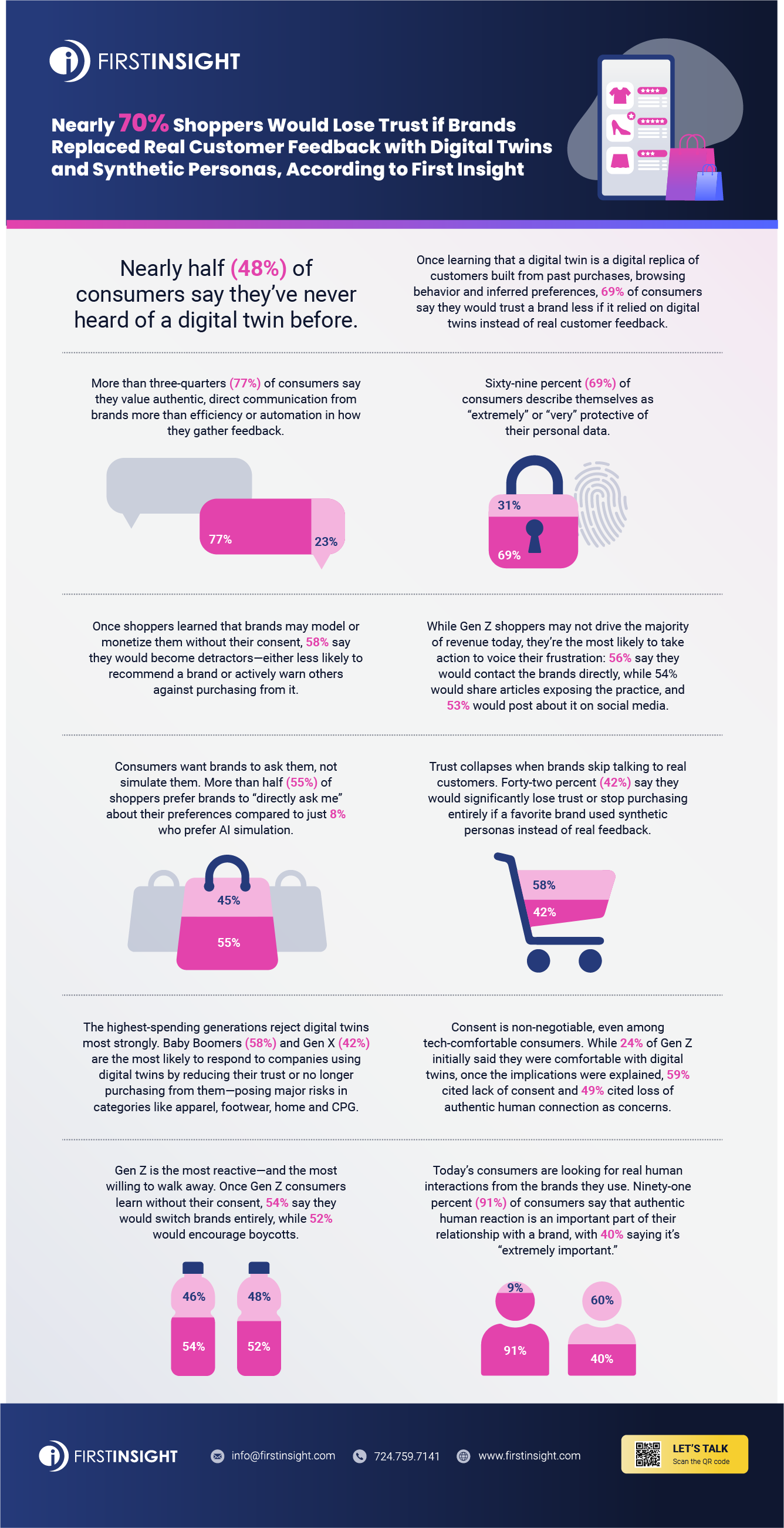
Nearly half (48%) of consumers have never heard of digital twins.
Silence is often misinterpreted as approval. But silence is not consent.
Once consumers learn that digital twins are digital replicas built from past purchases, browsing data, and inferred preferences—used to simulate their behavior without asking them anything—opinions shift immediately and dramatically:
- 69% would trust a brand less
- 42% would significantly lose trust or stop purchasing
- 58% would become detractors
This isn’t a soft decline in sentiment. It’s a collapse.
And it doesn’t stop at trust. It triggers a kinetic cascade of consumer reactions—reduced purchasing, brand switching, and even viral amplification.
The P&L Risk: The Highest Spending Generations Reject Digital Twins Hardest
Brands often assume younger consumers are the most sensitive to data privacy, but our findings show otherwise.
Baby Boomers (58%) and Gen X (42%)—the groups that drive the highest proportion of discretionary retail spending—are the most likely to reduce purchasing or stop buying altogether when learning a brand uses digital twins.
This creates direct financial exposure, particularly in categories where Boomers and Gen X dominate:
- Apparel
- Footwear
- Home
- Specialty
- CPG
Digital twins aren’t a shortcut to efficiency. They’re a shortcut to lost margin.
The Viral Risk: Gen Z Turns Digital Twin Usage Into a Public Crisis
While Boomers and Gen X represent the financial risk, Gen Z represents the reputational one.
When Gen Z discovers a brand is simulating them without consent, they take action - publicly, loudly, and quickly.
Here’s what Gen Z says they would do:
- 53% would post about it on social media
- 54% would share articles exposing the practice
- 52% would encourage boycotts
- 54% would switch brands
- 56% would contact the brand to complain
This is not theoretical. This is a documented chain reaction:
Awareness → Outrage → Sharing → Boycott → Abandonment → Direct confrontation
If even a fraction of Gen Z engages, brands lose control of the narrative within hours. One TikTok is all it takes.
The Accuracy Myth: Digital Twins Would Have Predicted the Wrong Outcome
Many retailers assume digital twins deliver better or faster predictions. But the data shows the opposite.
A synthetic model would look at Gen Z’s behavior - high tech adoption, comfort with apps, automation, and personalization - and conclude they would be comfortable with being modeled.
Some models would likely predict:
- “Gen Z is tech-comfortable”
- “Gen Z values efficiency”
- “Gen Z will accept digital twins”
But the real data tells a different story:
- 59% cite lack of consent as a concern
- 49% cite loss of authentic human connection
- 53% say they would post publicly
A digital twin would have predicted the opposite of what consumers actually feel.
That’s not predictive analytics.
That’s a blind spot.
Digital twins smooth over nuance, reinforce historical patterns, and ignore emerging sentiment - precisely the factors that determine future behavior.
What Consumers Actually Want: Ask Me, Don't Simulate Me
Our study revealed a sentiment that is both simple and profound:
Consumers don’t hate AI. They hate being simulated.
Here’s what they actually want:
- 55% want brands to directly ask them about preferences
- Only 8% prefer AI simulation
- 77% prefer authentic feedback collection over efficiency or automation
- 91% say authentic human reaction is important to their relationship with a brand
Consumers want agency. They want consent.
They want to be involved in decisions about them - not replaced by a mathematical approximation of themselves. Brands cannot claim to be consumer-centric while removing the consumer from the process.
The Path Forward for Retailers: AI Should Amplify Human Insight, Not Replace It
The answer isn’t to avoid AI. It’s to use AI differently - and responsibly.
The winning model is:
Real consumers → Real feedback → AI-powered analysis → Confident action
Retailers should:
- Engage real customers in real time
Ask shoppers directly what they think about new products, pricing, packaging, and experiences.
- Reward participation through loyalty and value exchange
Consumers are willing to share preferences when they feel valued, not processed.
- Use AI as an amplifier - not a substitute - for human experience
AI should help synthesize, categorize, predict, and scale insight…
Not replace the human voice.
The Bottom Line
Digital twins and synthetic personas aren’t just inaccurate - they’re dangerous.
They create:
- P&L risk (Boomers + Gen X reduce or stop buying)
- Reputational risk (Gen Z takes it public)
- Strategic risk (synthetic models predict the wrong outcomes)
- Trust risk (consumers respond with distrust, backlash, and switching)
Retailers win when they engage real consumers, honor authenticity, and build AI that strengthens - rather than replaces - the human connection.
Because you can’t build trust on a simulation. And you can’t predict customer behavior by removing the customer from the equation.
Ready to turn real customer insight into confident retail decisions? Book a call with the First Insight team and see how AI + authentic consumer data can protect trust, margins, and your P&L. 🐙✨
Book a complimentary 30-minute call below.